Showing posts with label citrus. Show all posts

Thursday, October 27, 2016

The Year of the Splitting Orange


Washington Navel and other varieties of citrus are beginning to ripen in our area, and many backyard gardeners are horrified at what they are seeing currently, wondering if Mother Nature is pulling some sort of Halloween prank.
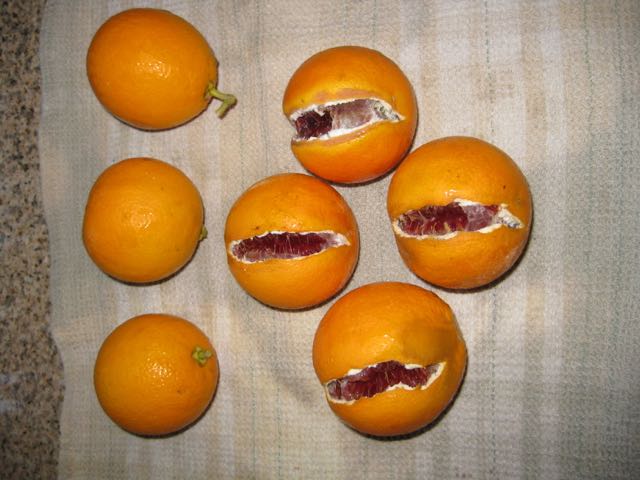
 
 Jim asks: “I have a beautiful navel orange tree and for the past two years the fruit keeps splitting. The oranges start out fine and all of a sudden as they get bigger, they split right down the middle.”
Donna chimes in: “My reliable orange tree is going south. I watered it for 10 minutes every morning and evening during summer. Is this splitting issue a disease?”
Teresa, writes to the garden e-mail bag: "My mom has a wonderful orange tree, and the fruit is just starting to grow. However, most of them are splitting before they even get larger than a fist. What makes them do that?"  Steve echoes this chorus: “Why are my oranges splitting now?”

You may be facing the same conundrum with your own backyard citrus.


    The short answer: splitting oranges are usually due to stress to the tree, usually a combination of fluctuating temperatures, humidity, soil moisture and possibly fertilizer levels. Oh, and an on-going drought.

    The long answer, from Pam Geisel, a UC Cooperative Extension Farm Advisor, who has studied the problem of citrus split: When hot weather is combined with high winds, navel orange trees become drought stressed and begin to take water from the young fruit, causing the fruit to soften and the leaves to cup. If the tree is then irrigated heavily, the dehydrated fruit swell, causing them to crack. Young trees or dwarf varieties with relatively small or shallow root systems, as well as trees grown in very sandy or porous soils that do not retain moisture well may be more susceptible to fruit splitting.
    Backyard gardeners can help minimize fruit split in navel oranges by paying attention to the summertime weather forecasts. When hot winds are predicted, irrigate before the winds begin. After the hot winds subside, irrigate lightly for a few days and then resume a normal irrigation schedule. Adding four inches of an organic mulch to the surface beneath the tree can also moderate soil moisture loss, as well as feeding the soil and controlling weeds.

Geisel also advises: "Instead of a single large application of quick release fertilizer each year, smaller monthly applications throughout the growing season (Feb. through May) may help keep nutrient levels constant."
Citrus grower Lance Walheim, author of the book, "Citrus", says that a good watering pattern for oranges includes adjusting it to the weather. Allow the top three or four inches to dry before irrigating deeply. He explains that too much water retards the spread of roots and promotes soil-borne diseases. An orange tree that gets too little water will grow poorly and may die. Keep an eye out for the signs of moisture stress on the orange trees: wilting or off-colored foliage.

    Ask a dozen citrus growers how they fertilize, and you may get 12 different answers. The University of California has several recommendations: "Apply one application of nitrogen (ammonium nitrate, ammonium sulfate, or urea) in late December to February. Alternatively, fertilizers can be applied in several applications. Many commercial growers apply 1/3 of the total nitrogen needed in February, July, and September. Using a balanced citrus food may help to correct mineral deficiencies as well as provide a more complete nutrition. Manure should be applied in the fall so that the winter rains can leach the salts. Steer and chicken manure should be used sparingly because they are high in salt and may burn the trees. Mature citrus trees use 1-1.5 lb. of actual nitrogen (N) per tree per year."
I'm no fan of quick release, ammonia-based products; it's too easy to apply too much, and could damage your tree. Others have weighed in on why these salt-containing formulations are bad for your garden. But for those of you that can't resist those $3 bags of Sulfate of Ammonia piled up outside the drug store, remember that Sulfate of Ammonia (20-0-0) consists of 20% actual nitrogen. So, applying one pound of actual nitrogen over three feedings per year per mature citrus tree equals about a pound and a half of ammonium sulfate per application, spread evenly beneath the outer dripline of the tree, following the label directions.
     My citrus feeding regimen for my containerized (half-barrels) citrus trees is organic, applied every other week during the growing season (February through September): a combination of water soluble fish emulsion and sea kelp. Fertilizer leaches through containerized plants more quickly than in-ground plants. So, a light feeding, but more often (every other week instead of monthly), mitigates that loss.

There are plenty of complete and balanced organic fertilizers available for fruit trees, some that only need to be applied a few times a year.
Timed-release synthetic fertilizers offer the convenience of supplying  nutrients at an even rate, but are usually more expensive. 
Whichever fertilizer you choose, apply it according to the label directions. 
     Lance Walheim also advises against fertilizing oranges after the end of summer. Late applications of fertilizer to deficient trees, he says, can lower fruit quality, make  the rind tougher and exposes new growth to the ill effects of a winter freeze.
    There are no pests or diseases that cause splitting, nor is there a chemical control for it, explains Pam Geisel. It is a problem that stems from environmental or cultural conditions. Blame the weather this year. Next year, mulch, water and fertilize that navel orange tree correctly to help minimize the fruit split.

Saturday, December 7, 2013

What to Do After a Hard Freeze

Sometimes a gardener feels as if they're in a heavyweight boxing match: Your Tender Plants vs. Mr. Freeze. Your citrus, succulents and perennials that may thrive in milder climates might be able to take a frosty punch or two here in the Sacramento/San Joaquin Valleys, foothills, and inland portions of the Bay Area. But five or six chilling blows to the flowers, leaves, stems and roots? 

We aren't talking about light frosts, or temperatures that hover around 30 degrees (F) for a couple of hours; that would be normal for this time of year. What area gardeners are going through right now is a week of extended hours of below freezing overnight temperatures, with prolonged bouts of plant-killing cold in the mid-to-low 20's. 

So, what should a shivering gardener do...post hard freeze? Should they:
a) remove all plants that look frost-bitten; 
b) prune away all freeze-damaged plant parts;

                   
c) Purchase and plant again this month those same varieties of trees, shrubs, perennials and annuals;
                 
d) Water the garden, even if the plants resemble toast;
            
e) Fight the urge to prune and plant by staying indoors, next to the wood stove.

The answers happen to be the easiest to accomplish on a cold weekend: d) and e).

If plants in your garden look blackened and wilted now, new growth may emanate from the base of the plant when the weather warms up in a couple of months.

New growth beneath the frosted branches of a geranium.


Pruning away the dead portions now exposes buds that may still be alive; another frosty morning could wipe out those survivors. 

The average frost season for Sacramento is about two months, primarily December and January. But temperatures below 32 have been recorded as early as the first week in November; as late as the third week in March.

So, keep the shears in the garage and let the dead portions of the plants protect the understory.  

It may take until mid-Spring before you see new growth. Patience is key before you pick up the pruners. In the meantime, tolerate the ugly.

Make sure your garden and potted plants remain moist, especially if it isn't raining. Water gives off heat, and this can protect plants from freezing, especially borderline citrus trees, such as lemons and limes. Damp soil retains heat better than dry soil, protecting roots and warming the air near the soil.

Succulents, such as cactus, are the exception, however. According to the Arizona-based Desert Botanical Garden, most succulents survive freezing temperatures best if the soil around them is dry. 

It's dead, Jim.
Some of those dead plants may be summer annuals, such as this impatiens, which took its sweet time to croak. Mornings hovering around 25 degrees can do that to a summer annual. Put them in the compost pile; plant more in the spring, after all danger of frost.

Frosty the Ficus


What about those plants that have frozen past the point of no return? Should you replace them with the same varieties? That frozen ficus (or avocado tree) may be Mother Nature's way of telling you: "Hey! This ain't San Diego! Pick outdoor plants that can take colder temperatures!"


Oh, and keep your frost protection gear handy...just in case.

Monday, November 25, 2013

Citrus, Frost and Mulch: Yes or No?


I love mulch. That would be obvious to anyone who has ever talked gardening with me. Big piles, small piles, inches of mulch scattered everywhere. Love it!


The benefits of adding organic mulch (wood chips, shredded tree limbs, pine needles, compost, straw) to the top of your garden soil:
• retains moisture
• keeps soil temperature constant, reducing plant stress
• suppresses weeds
• gradually increases soil organic matter
• attracts beneficial organisms that improve soil fertility and porosity.
• Mulch encourages healthier plants, reducing the needs for pesticides and fertilizers.
• protects roots and plants from mechanical injury.
• On hillsides and around homes, it suppresses the spread of brush fires.

But a long-held recommendation from the University of California flies in the face of the "all mulch, all the time" rule regarding protecting citrus from the effects of freezing temperatures: "A cover crop or mulch can lower minimum temperature at night, posing an increased threat from freeze damage." 

So, our advice has been over the years, "rake away mulch from beneath citrus before an expected frost or freeze".

Now, the California Landscape Contractors Association is offering the opposite advice in a release regarding frost protection: "Mulching with a partially composted material is one the best ways to protect plant roots because it helps insulate the soil, reducing heat loss and minimizing temperature fluctuations. Protecting the roots is necessary in order for them to survive the cold." The CLCA also points out: "Be sure to check the mulching material about once a month to make sure that moisture is getting to the soil below. Avoid using weed block materials, plastic or other moisture barriers beneath the mulch so that water can get to the roots. You may also need to water some of the drier areas in mid-December or mid-January if you find the soil dry."

So, who's right? Sacramento County Farm Advisor Chuck Ingels says: keep on mulching!

"The CLCA is right on," says Ingels. "In our mild climate, mulch doesn’t protect the tree from cold because the soil and roots really don’t ever freeze. Mulch protects the soil for other well known reasons. Regarding that UC study: years ago I thoroughly researched this and wrote about it in "Protecting Groundwater Quality in Citrus Production". In a large orchard, the best orchard floor conditions for reducing frost hazards is bare, firm and moist soil. The sun hits the soil and re-radiates the heat at night, warming the air. Tall cover crops are worst because not only do those plants not hold much heat, but tall cover crops raise the level of cold air (cold air sinks), increasing frost damage potential."

"Perhaps with just a few citrus trees there may be some benefit in this regard," Ingels concedes. "But any difference is generally very miniscule. What happens on the surrounding five acres (asphalt vs. buildings vs. bare ground) affects the air temperature around your tree. So, mulch away!"

ROOT ROTS + MOISTURE + MULCH = TROUBLE FOR CITRUS TREES But wait a minute, here's another reason why mulch and citrus trees may not be the best of friends: phytophthora. The spread of this root and crown rot fungal disease may actually be aided by too much mulch beneath shallow rooted citrus trees, especially in moist, slow-draining soils. According to the UC Division of Agriculture and Natural Resources book, Pests of Landscape Trees and Shrubs, "phytophthora kills the roots and root crown area of infected plants...possibly causing mature plants such as citrus to grow slowly and gradually decline... Phytophthora may affect only small feeder roots or rootlets, major roots or all roots and the crown... Because mulch retards drying of the soil and excess soil moisture greatly contributes to the development of root rots, improper or excessive use of mulch may actually promote root rot development."
TO MULCH OR NOT MULCH CITRUS? A COMPROMISE.
 If your soil drains easily and is not compacted, you may be able to get away with adding a few inches of mulch beneath your entire mature citrus trees, but keep the mulch from touching the trunk; six inches away, at a minimum. But if you have clay soil, slow draining or compacted soil, or just want to play it safe, Debbie Flower, Professor of Horticulture at American River College in Sacramento, offers this advice to stave off decline in a citrus tree: place the mulch from about two feet away from the trunk to beyond the outer canopy of the tree.


For newly planted citrus, move the mulch to the outer edge of the canopy (and beyond).


This way, the shallow roots near the root crown (as well as the crown area itself) have less of a chance of getting root rot problems. 


Another strategy: plant citrus in raised beds or containers to improve drainage. And perhaps a string or two of the old style C9 Christmas lights for some added heat on frosty nights. And while you're at it, perhaps some insulating pipe wrap around the trunk.

Thursday, November 1, 2012

November Frosts, Freezes Ahead? Probably.

 The typical Sacramento-area frost season (when temperatures dip to 32 or below for short periods of time) is fairly short: primarily, December and January.


However, November frosts do happen here with regularity. Freezes, too.
The earliest frost date for Sacramento was on a November 4, back in 1935, when the morning low fell to 30 degrees. The latest frost date recorded was on March 27, 1898, with a low of 32.
 
In 2011, a surprise cold snap on the morning of November 5 sent some areas in Sacramento County to freezing.

 Two years ago, there was a 2010 Thanksgiving surprise: the morning low temperatures in the suburbs of Sacramento dipped into freezing territory. 28 in Elk Grove. 24 in Rancho Cordova. 23 in Folsom. The temperatures in Rancho Cordova and Folsom stayed below 28 degrees for 7 hours that morning. That's a citrus-killing, perennial-punching hard freeze.
Freeze-Pummelled Pummelo

Not a Happy Hosta Thanksgiving


What is cold? Some definitions:

Frost: temperatures dip to 32 °F (0 °C) for short periods of time. Occurs with fair skies and light winds.

Freeze: temperatures at or below 32 °F

Hard Freeze: temperatures below 28 °F for several hours.

 Fruit-laden citrus trees could be threatened by very cold mornings in the weeks (or days) ahead. Some planning tips for the upcoming cold mornings:


Before a frost:
• Identify cold spots in landscape by monitoring with a thermometer that registers high and low temperatures.
• Identify plants at risk: citrus, succulents, tender perennials, tropical and subtropical plants.
• Have supplies ready: sheets or frost cloths, lights, wraps for trunks, thermometers, stakes or framework to hold covers off foliage.

• Prepare tender plants: avoid fertilizing and pruning after August to minimize tender new growth. 

• Plant insurance: In September and October, take cuttings from frost sensitive perennials; keep cuttings in a sunny, indoor area.

• Rake away mulch to allow soil to warm up during the day and radiate heat at night into plant.

• Monitor weather forecasts and note how low temperatures will be and for how long. 

Pipe Wrap: Cheap Frost Insurance


When a frost is forecast:
1. Move potted plants to a warmer spot next to house or under patio cover, especially on south side.

 2. Check that plants are well-watered since dry plants are more susceptible to damage, and moist soil retains heat better than dry soil.

3. Cover plants with a row cover before sunset to capture ground heat radiating upward at night, but remove covers daily if it is sunny and above freezing to allow soil to absorb heat.

4. Add heat by using outdoor lights: hang 100 watt drop lights or Holiday string lights to the interior of the plant. Use the old C7 or C9 large bulbs, not new LED lights which do not give off heat.

5. Wrap trunks of tender trees if hard freeze is expected, using towels, blankets, rags, or pipe insulation.

6. Harvest ripe citrus fruit. Generally, both green and ripe fruit are damaged below 30 degrees, but there is some variation by species (refer to the chart in UC/ANR Publication 8100, "Frost Protection for Citrus and Other Subtropicals").

7. Winterize your gasoline-powered garden equipment. Gas can go bad and screw up your engines if allowed to overwinter, unused. Drain the tanks or turn off the supply valve and run the engine until it stops. For containerized gas (or gas still in equipment) add a stabilizer. Run the engine for 10 minutes or so to make sure the stabilized gas is thoroughly mixed into the engine.

When a Freeze or Hard Freeze is Forecast (temperatures remain at or below 28 degrees for several hours)

 
1. Wrap any exposed plastic water pipes; use a cover for outdoor faucets. Turn off the water supply to outdoor irrigation faucets, if possible. Allow those faucets to drain.


2. Disconnect garden hoses and lay them out straight...away from driveways!


3. Adjust your pool, spa or pond filtration timers so that they are running when the chance of freezing temperatures is greatest, between two and nine a.m. Moving water is less susceptible to freezing.

4. For dish-shaped fountains: Turn off and let drain to the holding tank below ground. Remove any standing water in the dish.

Frosty the Fuchsia
After a frost:
1. Identify damage: dark brown or black leaves and twigs.

2. Wait to prune out damage until after danger of frost is past, and new growth begins in spring.

3. Make sure the backyard birdbath isn't frozen over in the morning. Daily fresh water for dogs and cats is also a good morning habit.

Tuesday, January 10, 2012

Controlling Sooty Mold


From the garden email bag, Gus from Lodi wants to know: “We have a great crop of oranges now despite the fact that many of the fruit and leaves are coated with a black substance that is easily washed off of the fruit. The fruit tastes great. Can you help? Thanks.”
 
 
That substance may be sooty mold, which is a fungus that results from the excrement of sucking insects such as aphids or scale.


According to the UC Davis Integrated Pest Management experts, sooty molds do not infect plants but grow on surfaces where those excrement deposits accumulate. This excrement, also known as honeydew, is a sweet, sticky liquid that plant-sucking insects excrete as they ingest large quantities of sap from a plant. Because the insect cannot completely utilize all the nutrients in this large volume of fluid, it assimilates what it needs and excretes the rest as honeydew. Wherever honeydew lands - leaves, twigs, fruit, yard furniture, concrete, sidewalks, or statuary - sooty molds can become established.

Although sooty molds do not infect plants, they can indirectly damage the plant by coating the leaves to the point that it reduces or inhibits sunlight penetration. Without adequate sunlight, the plant’s ability to carry on photosynthesis is reduced, which can stunt plant growth. Coated leaves also might prematurely age and die, causing premature leaf drop.
 
And as you pleasantly discovered, fruits or vegetables covered with sooty molds are edible. Simply remove the mold with a solution of mild soap and warm water.

To thwart any new outbreaks of sooty mold, do not overprune, overfertilize or overwater your pest-prone plants, says the University of Florida Ag Service. These bad habits can create weak, succulent new growth on the plants, a delicacy for sucking insects.


Beginning of sooty mold. Note the small white mass of scale on the stem.
To control sooty mold, you have to control the pests. On citrus, soft scales, such as cottony cushion scales, are the usual culprits. This scale can be controlled with a light horticultural oil when the scale are in their crawling stage.
Cottony cushion scale on mandarin branch

Sooty mold can attack any plant that may have an infestation of other sucking insects, especially aphids, leafhoppers, psyllids, and mealybugs.

The UCD IPM pros also advise against using insecticides containing the active ingredient imidacloprid for controlling this pest. Although scale is listed on the label as a pest that it can control, it is not effective against cottony cushion scale. 

Photo courtesy UC IPM

 To complicate matters, imidacloprid will reduce populations of the beneficial insect, the vedalia beetle. Both the adults and larvae of the Vedalia beetle feed exclusively on the cottony cushion scale on a variety of plants including rose, acacia, magnolia, olive, and citrus.


One product that can help control many of these pests, while washing off the sooty mold from leaves or fruit, is insecticidal soap. Even a blast of water from the hose can help wash off the sooty mold without harming any beneficial insects that might be trying to help you out. Horticultural oils or Neem oil can also suppress scale populations.

Also, look for ants crawling up and down the tree. Control the ants, and you can control the pests...as well as the sooty mold. Ants herd and protect sucking insects from beneficial insects, in order to harvest the honeydew for the ant colony.

Baits containing boric acid placed around the base of the tree will control ant populations in a couple of weeks. Sticky substances, such as Tanglefoot, although messy, can stop ants. See this previous post on ant control.


For plastic or painted surfaces that might have sooty mold, the USDA recommends this cleaning solution:


1/3 cup powdered household detergent 
1 quart household liquid bleach
2/3 of a cup of Trisodium phosphate
3 quarts of water. 

Be sure to wear rubber gloves when cleaning with this solution.

Monday, December 13, 2010

Mulch under Citrus Trees: Pros and Cons


I love mulch. That would be obvious to anyone who has ever talked gardening with me. Big piles, small piles, inches of mulch scattered everywhere. Love it!


The benefits of adding organic mulch (wood chips, shredded tree limbs, pine needles, compost, straw) to the top of your garden soil:
• retains moisture
• keeps soil temperature constant, reducing plant stress
• suppresses weeds
• gradually increases soil organic matter
• attracts beneficial organisms that improve soil fertility and porosity.
• Mulch encourages healthier plants, reducing the needs for pesticides and fertilizers.
• protects roots and plants from mechanical injury.
• On hillsides and around homes, it suppresses the spread of brush fires.

But a long-held recommendation from the University of California flies in the face of the "all mulch, all the time" rule regarding protecting citrus from the effects of freezing temperatures: "A cover crop or mulch can lower minimum temperature at night, posing an increased threat from freeze damage." 

So, our advice has been over the years, "rake away mulch from beneath citrus before an expected frost or freeze".

Now, the California Landscape Contractors Association is offering the opposite advice in a release regarding frost protection: "Mulching with a partially composted material is one the best ways to protect plant roots because it helps insulate the soil, reducing heat loss and minimizing temperature fluctuations. Protecting the roots is necessary in order for them to survive the cold."

So, who's right? Sacramento County Farm Advisor Chuck Ingels says: keep on mulching!

"The CLCA is right on," says Ingels. "In our mild climate, mulch doesn’t protect the tree from cold because the soil and roots really don’t ever freeze. Mulch protects the soil for other well known reasons. Regarding that UC study: years ago I thoroughly researched this and wrote about it in "Protecting Groundwater Quality in Citrus Production". In a large orchard, the best orchard floor conditions for reducing frost hazards is bare, firm and moist soil. The sun hits the soil and re-radiates the heat at night, warming the air. Tall cover crops are worst because not only do those plants not hold much heat, but tall cover crops raise the level of cold air (cold air sinks), increasing frost damage potential."

"Perhaps with just a few citrus trees there may be some benefit in this regard," Ingels concedes. "But any difference is generally very miniscule. What happens on the surrounding five acres (asphalt vs. buildings vs. bare ground) affects the air temperature around your tree. So, mulch away!"


ROOT ROTS + MOISTURE + MULCH = TROUBLE FOR CITRUS TREES
But wait a minute, here's another reason why mulch and citrus trees may not be the best of friends: phytophthora. The spread of this root and crown rot fungal disease may actually be aided by too much mulch beneath shallow rooted citrus trees, especially in moist, slow-draining soils. According to the UC Division of Agriculture and Natural Resources book, "Pests of Landscape Trees and Shrubs", "phytophthora kills the roots and root crown area of infected plants...possibly causing mature plants such as citrus to grow slowly and gradually decline... Phytophthora may affect only small feeder roots or rootlets, major roots or all roots and the crown... Because mulch retards drying of the soil and excess soil moisture greatly contributes to the development of root rots, improper or excessive use of mulch may actually promote root rot development."


TO MULCH OR NOT MULCH CITRUS? A COMPROMISE.
 If your soil drains easily and is not compacted, you may be able to get away with adding a few inches of mulch beneath your entire mature citrus trees, but keep the mulch from touching the trunk; six inches away, at a minimum. But if you have clay soil, slow draining or compacted soil, or just want to play it safe, Debbie Flower, Professor of Horticulture at American River College in Sacramento, offers this advice to stave off decline in a citrus tree: place the mulch from about two feet away from the trunk to beyond the outer canopy of the tree. 


For newly planted citrus, move the mulch to the outer edge of the canopy (and beyond). 


This way, the shallow roots near the root crown (as well as the crown area itself) have less of a chance of getting root rot problems. Another strategy: plant citrus in raised beds to improve drainage.


Monday, December 6, 2010

Holiday Lights for Frost Protection: Which to Choose?

 
"For frost protection of citrus, use the large, C9 Christmas/holiday lights..."

Now, there's a phrase we've been tossing around a lot lately.


To generate as much heat as possible into a citrus tree's canopy on a night when the temperature dips below freezing, stringing those C9 lights around the tree's interior is a good idea. Christmas lights work better than a single, large light bulb in the center of the tree canopy. It eliminates cold corners and edges. Those bulbs can add four degrees of protection. The combination of bulbs with a frost cloth will give you seven or eight degrees of extra warmth (be sure not to let the bulbs rest against the fabric or the leaves).
   
But after doing a little research, does it come as a surprise that not all C9 holiday lights are created equal?

The original C9 incandescent bulbs generated about 10 watts per bulb. Now, the selection of C9's (and the slightly smaller C7's) vary greatly: from 10 watts to less than 1 watt per bulb.
C7 (5 watts)
C9 (9 watts)
LED C7 (less than one watt)


If you're buying C9 lights for frost protection, be sure to read the label. You want as much heat as possible.


The output among various style C9 and C7 holiday lights from one online retailer:  
.6 Watts - LED C7    

1 Watt - LED C9   
2.5 Watts - Low Energy C7  
3.7 Watts - Low Energy C9
5 Watts - Traditional C7 
7 Watts - Traditional C9 
10 Watts - Traditional C9


And the information on the package can be tricky. One box of Christmas lights I found in the garage was labeled "C9 Style". Turns out, only the covering of the bulb was C9 in style; the output of the bulb itself was .75 of a watt.


Besides being festive this time of year with your citrus, you can extend the colorful light show to your cold frames.
  
In trials conducted by Colorado State University, one 25 light string of C-7 (mid-size) Christmas lights per frame unit (four feet wide by five feet long) gave 6 degrees F to over
18 degrees F frost protection.  Lights were hung on the frame under the plastic and turned on at dusk and off at dawn. 

Thursday, November 18, 2010

Citrus Protection in a Frost or Freeze


We are now officially entering the shivering season for the Central Valley, Bay Area and low foothills. Late November through mid-February is the most critical time for protecting frost-susceptible plants.


This is especially true for citrus tree owners, who are anxiously keeping an eye out on the upcoming weather forecasts.

For instance, the current seven day forecast for Sacramento calls for overnight temperatures to drop into the low 30's, Sunday through Tuesday. But depending where you live, it could be lower; all gardening is local.

Several days before an expected frost (temperatures dipping down to 32 degrees) is the time to gather the necessary implements to protect your citrus trees, including giving the ground beneath them a good soaking (moist soil is better than dry soil at moderating the temperature beneath the tree).

Most gardeners first thoughts about protecting their citrus trees during a frost or freeze is, "protect the fruit!"

Four Winds Growers, the Winters-based wholesale grower of many excellent varieties of citrus, offers the Citrus Variety Information Chart at their website, FourWindsGrowers.com

Included in that chart is extensive information about each citrus variety, including suitability for indoor growing; its bloom and fruiting seasons; its recommended summer heat level to produce good fruit; and, its minimum tolerable temperature for preservation of fruit quality.

  The chart points out that lemons, limes and citrons are most sensitive to frost, while sweet oranges, grapefruit, tangerines and calamondins are intermediate. Kumquats and Owari Satsuma Mandarins are the most frost-tolerant, braving temperatures into the twenties (that would classify as a freeze).

From that chart, here are the temperatures (in degrees Fahrenheit) at which citrus fruit damage may occur.

Sweet Oranges
Washington Navel Orange  28  
Trovita Orange  28  
Cara Cara (Pink) Navel Orange 28  
Lane Late Navel Orange  28  
Robertson Navel Orange  28  
Shamouti Orange (Jaffa Palestine)  28  
Valencia Orange  28  
Midknight Valencia Orange  28  
 
Blood Oranges
Moro Blood Orange  28   
Sanquinelli Blood Orange  28   
Tarocco Blood Orange  28   
 
Sour Oranges
Bouquet De Fleurs Sour Orange  28   
Chinotto Sour Orange (Myrtle-Leaf)  28  
Seville Sour Orange  28  
Bergamot Sour Orange  32  
 
Mandarins
Gold Nugget Mandarin (Patented)  26  
Tango Mandarin (Patented)  32 
Owari Satsuma Mandarin  24  
Dancy Tangerine  32  
Clementine Mandarin (Algerian)  28  
Murcott Mandarin  32  
California Honey Mandarin  32  
W. Murcott Mandarin  32  
Kinnow Mandarin  32  
Kara Mandarin  32  
Page Mandarin  32  
Piie Mandarin  32  
Kishu Mandarin  32  
 
Lemons
Improved Meyer Lemon  32  
Eureka Lemon  32  
Lisbon Lemon  32  
Ponderosa Lemon  32  
Variegated Pink Lemon  32  
Yen Ben Lemon  32  

 
Mediterranean Lemons
Villafranca Lemon  32  
Genoa Lemon (Gea)  32  
Limonero Fino Lemon  32  
 
Limettas
Millsweet Acidless Limetta  32  
Marrakech Limetta  32  
 
Limes
Bearss Seedless Lime (TahitiPersian)  30  
Kaffir Lime (KiefferThaiWild)  32  
Meican Lime (Key)  32  
Thornless Meican Lime  32  
Meican Sweet Lime  30  
Palestine Sweet Lime  30  
Rangpur Lime  32  
 
Grapefruits
Oroblanco Grapefruit  32  
Rio Red Grapefruit  28  
Star Ruby Grapefruit  28  
Chandler Pummelo  28  
Cocktail Grapefruit  28  
Chinese Grapefruit  28  
Melogold Grapefruit  28  
 
Kumquats
Meiwa Kumquat  28  
Nagami Kumquat  24  
Indio Mandarinquat  26  
Centennial Variegated Kumquat  30  
Nordmann Seedless Nagami Kumquat  28  
Marumi Kumquat  26  
Eustis Limequat  32  
 
Citrons
Buddha's Hand  Fingered Citron  32  
Etrog Citron (Ethrog)  32  
 
Other Interesting Varieties
Minneola Tangelo  28   
Australian Finger Lime  32   
Yuzu  24   
Calamondin  32 
Variegated Calamondin  32


But what about the overall health of the citrus tree? How low can temperatures go during a freeze event before the tree is toast?

 "I consider 22 degrees to be terminal for citrus tree cambium cells," says Cedar Seeger of Four Winds Growers. The cambium layer is the growing part of the tree, the cells that are producing new wood and healing wounds. It is located just beneath the bark.

And that's for a citrus tree in tip-top shape: good health, with moist soil around it during a freeze. Cedar uses the example of a Meyer lemon tree:

"
We often have a two to three hour dip to 28 degrees after storms; and if the above conditions are met, even Meyer lemon trees can survive, albeit not to happily, without protection. 28 degrees for four hours probably won't kill the tree, provided the rootstock cambium doesn't freeze. It will defoliate and lose twigs. At 24 degrees things start to get dicey.
  
Ideally, this frost blanket should be touching the ground.


That's when the frost blanket, bonnet and lights will work wonders. Remember, those blankets and bonnets need to go to the ground in all cases."


When a large, cold-air mass moves in from the north after a storm in the winter, that is called an advective freeze. The one that sticks out in most gardeners' memories here was the freeze of mid-December 1990, when nighttime temperatures fell into the teens for several days in a row, with a couple of days that didn't climb above 32 degrees. To add even more injury, a second cold snap hit near the end of the month, with temperatures dipping into the mid-20's. Many of the most susceptible (frost intolerant) landscapes were completely lost; some nurseries never recovered.

"Our first year in the citrus business here in Winters was 1990-91. My wife, Mary Helen, and I have a Masters in Disaster," says Seeger. 

Which is why Cedar is an adherent of watching the dew point, the temperature at which saturation has been reached, when water vapor condenses into water. The lower the dew point, the more danger of cold damage to your plants. One good online source for dew point temperatures is the National Weather Service's Tabular Forecast Page  , which offers a forecast for two days in advance (that link is for Sacramento).

"A good watering going into an advection night is mandatory. If the ground and surrounding grass is wet, it creates a micro dew point environment around the trees. In a dry, cold La Nina winter such as we're about to get, it is important to remember the dew point concept. At 22 and below, it's full on emergency response, pile straw, hay around trunks, anything, lights, covering," says Cedar, a man who learned these lessons the hard way.  But he is not an adherent of running sprinklers during a freeze.


"My experience with overhead sprinklers is that they more often than not freeze up, and then it's all over. And you are risking branch breakage on that ice-entombed citrus. Yeah, it can work, but screw it; it's messy, risky and a lot of work. Use the large Christmas lights and mid-weight frost covers. But pay attention to the trunk / rootstock. If that freezes, it's a goner."


Citrus trees most at risk to fatal damage from a frost or freeze are the young trees. It is vital that they be covered completely when a heavy frost or freeze is predicted, and provide protection for the trunk, bud union and rootstock area. That can include trunk wraps, newspapers, old carpeting. 

In his book, "Citrus" , author and grower Lance Walheim also suggests applying a copper-based fungicide to the trunk and then mounding or banking soil against the trunk and lower limbs. Just don't leave it on too long; fungal rots can develop (that copper can only work for a limited time). He advises leaving that soil next to the trunk from Thanksgiving until February, or March, in colder areas.


And Thanksgiving, by the way, is next Thursday.