Showing posts with label frost. Show all posts

Monday, February 19, 2018

What Should You Do For Your Plants AFTER a Freeze?

Sometimes a gardener feels as if they're in a heavyweight boxing match: Your Tender Plants vs. Mr. Freeze. Your citrus, succulents and perennials that may thrive in milder climates might be able to take a frosty punch or two here in the Sacramento/San Joaquin Valleys, foothills, and inland portions of the Bay Area. But several cold blows to the flowers, leaves, stems and roots? 

We aren't talking about light frosts, or temperatures that hover around 30 degrees (F) for a couple of hours; that would be normal; the possibility of a frost in Sacramento is anytime between November and late March. The most typical frost period here is December and January. Usually by late February, gardeners thoughts - mistakenly - have turned to planting warm season annuals and putting away the frost cloths for the season. What area gardeners are going through right now is several days of extended hours of below freezing overnight temperatures, with prolonged bouts of plant-killing cold in the mid-to-low 20's. 

So, what should a shivering gardener do...after a hard freeze, when temperatures are at or below 28 degrees for several consecutive hours? Should they:
a) remove all plants that look frost-bitten; 
b) prune away all freeze-damaged plant parts;

                   
c) Purchase and plant again this month those same varieties of trees, shrubs, perennials and annuals;
                 
d) Water the garden, even if the plants resemble toast;
            
e) Fight the urge to prune and plant by staying indoors, next to the wood stove.

The answers happen to be the easiest to accomplish on a cold weekend: d) and e).

If plants in your garden look blackened and wilted now, new growth may emanate from the base of the plant when the weather warms up in a couple of months.

New growth beneath the frosted branches of a geranium.

Pruning away the dead portions now exposes buds that may still be alive; another frosty morning could wipe out those survivors. Keep the shears in the garage and let the dead portions of the plants protect the understory.
 
 It may take until mid-Spring before you see new growth. Patience is key before you pick up the pruners. In the meantime, tolerate the ugly.

Make sure your garden and potted plants remain moist, especially if it isn't raining. Water gives off heat, and this can protect plants from freezing, especially borderline citrus trees, such as lemons and limes. Damp soil retains heat better than dry soil, protecting roots and warming the air near the soil.

Succulents, such as cactus, are the exception, however. According to the Arizona-based Desert Botanical Garden, most succulents survive freezing temperatures best if the soil around them is dry. 
It's dead, Jim.
Some of those dead plants may be summer annuals that survived our unusually mild early and mid-winter. This impatiens,  for example took its sweet time to croak. Mornings hovering around 25 degrees can do that to a summer annual. Put them in the compost pile; plant more in the spring, after all danger of frost.

Frosty the Ficus
What about those plants that have frozen past the point of no return? Should you replace them with the same varieties? That frozen ficus may be Mother Nature's way of telling you: "Hey! This ain't San Diego! Pick outdoor plants that can take colder temperatures!"


Oh, and keep your frost protection gear handy...just in case.

Monday, February 18, 2013

Global Warming and Gardeners: It’s Not Just the Heat

Should gardeners be concerned about global warming? Politics aside, climate change is already manifesting itself in our yards. The Climate Nexus think tank explains that what we are seeing is called “season creep”: winters are shorter and milder, causing some plants to bloom earlier than we would normally expect. For example, many area fruit and nut trees were ahead of their typical blooming curve, sending out blossoms in an atypically warmer early February before gardeners were ready to apply their last round of dormant spray.


Although that is more of an inconvenience than a problem, climate change is producing other, more profound effects in our yards, according to Climate Nexus:

• Frost vulnerability.
High winter temperatures can create earlier flowering schedules, leaving blooms at risk of a late freeze. Although it sounds counter-intuitive given the warming we are experiencing, cold snaps are still projected to happen even during warmer-than-average springs. This is of greatest concern to commercial fruit farmers, who lose their crop if a frost destroys the flowers. Or fruit. At the other end of the calendar, early freezes in the fall can cause losses to many summer crops that are still being harvested. 

Frosty the Pummelo

On November 10, 2011, our area shivered through one of the earliest freezes on record: 32 degrees, 11 degrees below average. Bell pepper and lettuce growers reported crop losses after that incident. In addition, backyard gardeners who were still harvesting tomatoes suffered, too. And this week's forecast? Rain, thunderstorms, hail ... and cold. Overnight lows are expected to dip to 30 degrees in parts of Sacramento on Tuesday night. A normal low for mid to late February is 44 degrees. The record low temperature for Tuesday? 33 degrees.

• Species mismatch. Research shows that species differ in their ability to adjust life cycles to warming temperatures. If one species adjusts and the other does not, for instance, flowering times can end up out of sync with peak pollinator activity. 
Mismatches can also occur between predators and their prey, which may affect gardeners interested in attracting birds to their gardens. For example, the pied flycatcher now migrates at the wrong time relative to the availability of its insect prey, and as a result has experienced population declines of 90 percent in some areas.

• Pests and invasives. Season creep provides favorable conditions to many pests and invasive species. In the western U.S., harsh winters normally cull the bark beetle population, but recent mild winters have allowed their population to skyrocket. Gypsy moths and tent caterpillars are also expected to expand their ranges thanks to the changing seasons. Invasive plant species are by no means uniform in their response to climate change, but research indicates that in many cases they will be able to adapt more effectively to season creep than native species. This was the case at Thoreau’s Walden Pond, where invasive species slowly drove out native plants as the climate shifted.

So, what is a gardener to do? Be vigilant. And keep those frost covers handy this week.


Thursday, November 1, 2012

November Frosts, Freezes Ahead? Probably.

 The typical Sacramento-area frost season (when temperatures dip to 32 or below for short periods of time) is fairly short: primarily, December and January.


However, November frosts do happen here with regularity. Freezes, too.
The earliest frost date for Sacramento was on a November 4, back in 1935, when the morning low fell to 30 degrees. The latest frost date recorded was on March 27, 1898, with a low of 32.
 
In 2011, a surprise cold snap on the morning of November 5 sent some areas in Sacramento County to freezing.

 Two years ago, there was a 2010 Thanksgiving surprise: the morning low temperatures in the suburbs of Sacramento dipped into freezing territory. 28 in Elk Grove. 24 in Rancho Cordova. 23 in Folsom. The temperatures in Rancho Cordova and Folsom stayed below 28 degrees for 7 hours that morning. That's a citrus-killing, perennial-punching hard freeze.
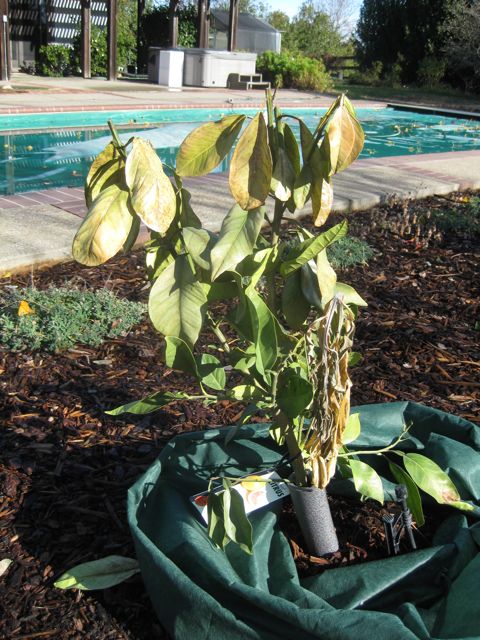
Freeze-Pummelled Pummelo

Not a Happy Hosta Thanksgiving


What is cold? Some definitions:

Frost: temperatures dip to 32 °F (0 °C) for short periods of time. Occurs with fair skies and light winds.

Freeze: temperatures at or below 32 °F

Hard Freeze: temperatures below 28 °F for several hours.

 Fruit-laden citrus trees could be threatened by very cold mornings in the weeks (or days) ahead. Some planning tips for the upcoming cold mornings:


Before a frost:
• Identify cold spots in landscape by monitoring with a thermometer that registers high and low temperatures.
• Identify plants at risk: citrus, succulents, tender perennials, tropical and subtropical plants.
• Have supplies ready: sheets or frost cloths, lights, wraps for trunks, thermometers, stakes or framework to hold covers off foliage.

• Prepare tender plants: avoid fertilizing and pruning after August to minimize tender new growth. 

• Plant insurance: In September and October, take cuttings from frost sensitive perennials; keep cuttings in a sunny, indoor area.

• Rake away mulch to allow soil to warm up during the day and radiate heat at night into plant.

• Monitor weather forecasts and note how low temperatures will be and for how long. 

Pipe Wrap: Cheap Frost Insurance


When a frost is forecast:
1. Move potted plants to a warmer spot next to house or under patio cover, especially on south side.

 2. Check that plants are well-watered since dry plants are more susceptible to damage, and moist soil retains heat better than dry soil.

3. Cover plants with a row cover before sunset to capture ground heat radiating upward at night, but remove covers daily if it is sunny and above freezing to allow soil to absorb heat.

4. Add heat by using outdoor lights: hang 100 watt drop lights or Holiday string lights to the interior of the plant. Use the old C7 or C9 large bulbs, not new LED lights which do not give off heat.

5. Wrap trunks of tender trees if hard freeze is expected, using towels, blankets, rags, or pipe insulation.

6. Harvest ripe citrus fruit. Generally, both green and ripe fruit are damaged below 30 degrees, but there is some variation by species (refer to the chart in UC/ANR Publication 8100, "Frost Protection for Citrus and Other Subtropicals").

7. Winterize your gasoline-powered garden equipment. Gas can go bad and screw up your engines if allowed to overwinter, unused. Drain the tanks or turn off the supply valve and run the engine until it stops. For containerized gas (or gas still in equipment) add a stabilizer. Run the engine for 10 minutes or so to make sure the stabilized gas is thoroughly mixed into the engine.

When a Freeze or Hard Freeze is Forecast (temperatures remain at or below 28 degrees for several hours)

 
1. Wrap any exposed plastic water pipes; use a cover for outdoor faucets. Turn off the water supply to outdoor irrigation faucets, if possible. Allow those faucets to drain.


2. Disconnect garden hoses and lay them out straight...away from driveways!


3. Adjust your pool, spa or pond filtration timers so that they are running when the chance of freezing temperatures is greatest, between two and nine a.m. Moving water is less susceptible to freezing.

4. For dish-shaped fountains: Turn off and let drain to the holding tank below ground. Remove any standing water in the dish.

Frosty the Fuchsia
After a frost:
1. Identify damage: dark brown or black leaves and twigs.

2. Wait to prune out damage until after danger of frost is past, and new growth begins in spring.

3. Make sure the backyard birdbath isn't frozen over in the morning. Daily fresh water for dogs and cats is also a good morning habit.

Sunday, November 28, 2010

Post-Freeze Garden Tips

The average frost season for Sacramento is about two months, primarily December and January. But temperatures below 32 have been recorded as early as the first week in November; as late as the third week in March. This year, it was a Thanksgiving freeze, when temperatures plummeted into the low 20's Thursday morning, remaining there for more than 8 hours. Friday morning's lows also dipped into the 20's. And that's a recipe for definite plant damage.
 After several days of bone-chilling mornings with temperatures dipping into the low-to-mid twenties, should shivering gardeners:

a) remove all plants that look frost-bitten; 
 
b) prune away all freeze-damaged plant parts;

c) Purchase and plant again this weekend those same varieties of trees, shrubs, perennials and annuals;


d) water the garden, even if the plants resemble toast;
            
e) fight the urge to prune and plant by staying indoors, next to the wood stove?

The answers happen to be the easiest to accomplish on a cold weekend: d) and e).

Even if plants in your garden look blackened and wilted now, new growth may emanate from the base of the plant when the weather warms up in a couple of months.

Pruning away the dead portions now exposes buds that may still be alive; another frosty morning could wipe out those survivors. 


Hostas will get new growth from the base.
Parsley can take a freeze. Tomatoes? No.

So, keep the shears in the garage and let the dead portions of the plants protect the understory. It may take until mid-Spring before you see new growth; patience is key before you pick up the pruners.

Make sure your garden and potted plants remain moist. Water
gives off heat, and this can protect plants from freezing, especially borderline citrus trees, such as lemons and limes. Damp soil retains heat better than dry soil, protecting roots and warming the air near the soil.


Other frosty garden tips that bear repeating:
• If you still have cold-susceptible potted plants on the porch or patio, move them to a sunny spot indoors or to a west or south-facing outdoor wall.

• Another way to achieve a few degrees of protection: construct a tent around a freeze-threatened plant, especially citrus, using frost blankets or row cover material. Your local nursery will have several products that will do this job. Old bed sheets work well, too.

• The larger sized Christmas lights or a couple of 150-watt light bulbs located in the central area of an orange tree (or any other cold-intolerant shrub) may add two to four degrees Fahrenheit of protection.

• Harvest any citrus fruit that is ripe, especially on the outer
branches.

• Wrap any exposed plastic water pipes; cover outdoor faucets, as well.

• Adjust your pool, spa or pond filtration timers so that they are running when the chance of freezing temperatures is greatest, between 2 and 9 a.m. Moving water is less susceptible to freezing.

• Make sure the backyard birdbath isn't frozen over in the morning.

• Daily fresh water for dogs and cats is also a good morning habit.

And what about those plants that have frozen past the point of
return? Should you replace them with the same varieties? That frozen ficus may be Mother Nature's way of telling you: "Hey! This ain't San Diego! Pick outdoor plants that can take colder temperatures!"


Coleus, a summer annual here: It's dead, Jim.

From the garden e-mail bag, Rob asks: "A lot of my lantana was burned by the cold weather. Should I trim in winter or wait until spring?"
Lantana is from the tropics, so it is a borderline plant here.
A light frost usually just damages the outer leaves; but a heavy frost or freeze may kill the entire plant. The good news: it may come back to life with new growth from the base, but not until late in spring. In the meantime, do nothing. Those dead branches may be keeping the base alive.

Tuesday, November 23, 2010

Walnut Trees At Risk in November Freeze

As if protecting your citrus trees and tender perennials from an impending November freeze isn't enough to fill your day. Walnut trees, too, are at risk when the temperatures plummet to the 20's in November.

True, the walnut harvest is mostly done by now. But the walnut tree itself could be injured or killed by a November freeze if the tree hasn't entered dormancy.

Check your walnut trees. If you see emerging leaves at the shoot tips this time of year, your walnut tree is not in dormancy. 

A prolonged, late autumn freeze following a period of relatively mild weather (remember the 70's last week, including a high in the 80's on Nov. 16) sets the table for walnut tree damage to vigorously growing, non-dormant young trees. 

Trees that have been hardened off are less susceptible to damage in an autumn frost.  But in the winter, even dormant, mature walnut trees can be injured by extreme cold.

According to UC Farm Advisor Carolyn DeBuse, both types of cold damage (autumn and winter) show similar symptoms of darkening bark and streaks of gray on the inner wood. In the spring, buds are slow to break or fail to break altogether. In cases where the branch dies, the winter kill acts as a severe pruning and vigorous shoots grow from below the damaged area. Sunburn often accompanies the cold damage increasing the amount of injury. In the harshest instances, entire young trees can die.

The good news: this usually happens only to walnut trees that are drought-stressed or are in dry, sandy soil. The copious rainfall we have had this autumn may lessen the chances of frost damage.

DeBuse points out that a good precautionary measure to take after a frost or freeze is to paint the trunks of the walnut trees. This is effective in reducing damage to young trees after a November frost. Paint the tree trunks and primary scaffolds above the crotch with a whitewash made of white interior latex paint diluted with 50% water. The paint will help prevent sunburn and help heal the damaged wood by reducing evaporation from the injury. In a study by Wilbur Reil, Yolo/Solano Farm Advisor Emeritus, 46% of unpainted trees sustained cold damage while only 8% of the trees painted 8 days after the event showed damage.

And just as we've recommended before with other plants that get frozen back, Dubose says not to prune out damaged walnut limbs in the spring. The buds may be slow to open. Don't prune out any suspected dead wood until the late summer. And she suggests to reduce or delay any applications of fertilizer to your walnut trees in the spring where cold damage has been spotted.

Read about more steps DuBose suggests for reducing freeze damage to walnut trees here.

Sunday, November 21, 2010

Thanksgiving Freeze Predicted. Is Your Yard Ready?

  Last week, we talked about strategies to protect your citrus trees from any expected mild frosts, when morning temperatures dip just below 32 degrees for an hour or two. 

     But what if the often predicted fall/winter freeze, when temperatures fall into the 20's for several hours each morning, settles into the area? The National Weather Service is forecasting overnight lows to dip below freezing, with many places just outside Sacramento falling into the 20's Tuesday, Wednesday and Thursday (Thanksgiving) this week. What else needs to be done in the yard to prep for a prolonged freeze when temperatures are forecast to fall to the upper 20's for several hours?
    

     Many of us learned this drill back in 1990, when consecutive low morning temperatures of 22, 18, 21 and 23 in Sacramento descended upon us during the period of December 21-24. Temperatures did not get above 25 degrees in parts of the San Joaquin Valley for three to five days and all time record low temperatures were set at Sacramento, Stockton, and Bakersfield. Many records were set for duration of freezing temperatures. The agricultural industry was devastated as acres of trees, not just fruit, were destroyed. Thirty-three counties were disaster-declared.

     Homeowners learned which plants don't like it cold (hibiscus, geraniums and other plants popular in the Bay Area and Southern California); and, which plants were the hardy survivors (another reason the oleander was chosen for the Highway 99 median strip). 

     Here's a last minute checklist for your home and garden if the TV weather people tell you tomorrow's low will be in the 20's:
 
• If it hasn't rained, water plants thoroughly, especially container plants.

 
• If possible, move sensitive container plants next to a south or west facing wall.

 
• Cover citrus and other sensitive plants with burlap, row cover fabric or sheets (be sure to keep the sheets dry). Tent plastic sheets over the plants; don't let plastic touch plant leaves. A light bulb placed in such a plant can offer a few degrees of protection.

 
• If using an anti-transpirant polymer coating material such as Wilt-Pruf or Cloud Cover, apply at the warmest time of the day, or at least six hours before an expected frost. However, research conducted at Washington State University concluded that these products may actually be detrimental to certain plants during a freeze. If using these products, thoroughly water the soil around the plant before applying.

 
• Disconnect hoses and drip lines, removing end caps. Lay out straight.

 
• To prevent broken grass blades, don't walk on a frozen lawn.

 
• Remove the lowest sprinkler head to drain.

 
• Cover unprotected faucets and pipes, including any spa or pool equipment.

 
• If temperatures are predicted to fall to the low 20's: prevent frozen attic pipes. Let lukewarm water trickle out of the indoor faucet farthest from the inlet. Also, let faucets with pipes running along an outer, north facing wall trickle during the night. 


• Ideally, add insulation to attic water pipes.
 
• Open cabinet doors to get more heat to the pipes. Close the garage door if water pipes pass through the garage.

 
• Setting your thermostat nightly at 55 can add needed heat to the attic pipes.

 
• If leaving the house for a Thanksgiving vacation during an expected freeze, turn off the water to the house, and open up the faucet farthest from the inlet. Be sure to turn off your water heater.

 
• To prevent cracking tile, run your pool and spa equipment during the freezing hours.


• Don't forget about your pets during a prolonged freeze. Bring them indoors at night. Move or replace their drinking water. Break up any frozen water in bird baths.


Their is some good news connected with a possible freeze: populations of yellowjackets, eucalyptus-feeding red gum lerp psyllids and grasshoppers could be greatly reduced in 2011.

Thursday, November 18, 2010

Citrus Protection in a Frost or Freeze


We are now officially entering the shivering season for the Central Valley, Bay Area and low foothills. Late November through mid-February is the most critical time for protecting frost-susceptible plants.


This is especially true for citrus tree owners, who are anxiously keeping an eye out on the upcoming weather forecasts.

For instance, the current seven day forecast for Sacramento calls for overnight temperatures to drop into the low 30's, Sunday through Tuesday. But depending where you live, it could be lower; all gardening is local.

Several days before an expected frost (temperatures dipping down to 32 degrees) is the time to gather the necessary implements to protect your citrus trees, including giving the ground beneath them a good soaking (moist soil is better than dry soil at moderating the temperature beneath the tree).

Most gardeners first thoughts about protecting their citrus trees during a frost or freeze is, "protect the fruit!"

Four Winds Growers, the Winters-based wholesale grower of many excellent varieties of citrus, offers the Citrus Variety Information Chart at their website, FourWindsGrowers.com

Included in that chart is extensive information about each citrus variety, including suitability for indoor growing; its bloom and fruiting seasons; its recommended summer heat level to produce good fruit; and, its minimum tolerable temperature for preservation of fruit quality.

  The chart points out that lemons, limes and citrons are most sensitive to frost, while sweet oranges, grapefruit, tangerines and calamondins are intermediate. Kumquats and Owari Satsuma Mandarins are the most frost-tolerant, braving temperatures into the twenties (that would classify as a freeze).

From that chart, here are the temperatures (in degrees Fahrenheit) at which citrus fruit damage may occur.

Sweet Oranges
Washington Navel Orange  28  
Trovita Orange  28  
Cara Cara (Pink) Navel Orange 28  
Lane Late Navel Orange  28  
Robertson Navel Orange  28  
Shamouti Orange (Jaffa Palestine)  28  
Valencia Orange  28  
Midknight Valencia Orange  28  
 
Blood Oranges
Moro Blood Orange  28   
Sanquinelli Blood Orange  28   
Tarocco Blood Orange  28   
 
Sour Oranges
Bouquet De Fleurs Sour Orange  28   
Chinotto Sour Orange (Myrtle-Leaf)  28  
Seville Sour Orange  28  
Bergamot Sour Orange  32  
 
Mandarins
Gold Nugget Mandarin (Patented)  26  
Tango Mandarin (Patented)  32 
Owari Satsuma Mandarin  24  
Dancy Tangerine  32  
Clementine Mandarin (Algerian)  28  
Murcott Mandarin  32  
California Honey Mandarin  32  
W. Murcott Mandarin  32  
Kinnow Mandarin  32  
Kara Mandarin  32  
Page Mandarin  32  
Piie Mandarin  32  
Kishu Mandarin  32  
 
Lemons
Improved Meyer Lemon  32  
Eureka Lemon  32  
Lisbon Lemon  32  
Ponderosa Lemon  32  
Variegated Pink Lemon  32  
Yen Ben Lemon  32  

 
Mediterranean Lemons
Villafranca Lemon  32  
Genoa Lemon (Gea)  32  
Limonero Fino Lemon  32  
 
Limettas
Millsweet Acidless Limetta  32  
Marrakech Limetta  32  
 
Limes
Bearss Seedless Lime (TahitiPersian)  30  
Kaffir Lime (KiefferThaiWild)  32  
Meican Lime (Key)  32  
Thornless Meican Lime  32  
Meican Sweet Lime  30  
Palestine Sweet Lime  30  
Rangpur Lime  32  
 
Grapefruits
Oroblanco Grapefruit  32  
Rio Red Grapefruit  28  
Star Ruby Grapefruit  28  
Chandler Pummelo  28  
Cocktail Grapefruit  28  
Chinese Grapefruit  28  
Melogold Grapefruit  28  
 
Kumquats
Meiwa Kumquat  28  
Nagami Kumquat  24  
Indio Mandarinquat  26  
Centennial Variegated Kumquat  30  
Nordmann Seedless Nagami Kumquat  28  
Marumi Kumquat  26  
Eustis Limequat  32  
 
Citrons
Buddha's Hand  Fingered Citron  32  
Etrog Citron (Ethrog)  32  
 
Other Interesting Varieties
Minneola Tangelo  28   
Australian Finger Lime  32   
Yuzu  24   
Calamondin  32 
Variegated Calamondin  32


But what about the overall health of the citrus tree? How low can temperatures go during a freeze event before the tree is toast?

 "I consider 22 degrees to be terminal for citrus tree cambium cells," says Cedar Seeger of Four Winds Growers. The cambium layer is the growing part of the tree, the cells that are producing new wood and healing wounds. It is located just beneath the bark.

And that's for a citrus tree in tip-top shape: good health, with moist soil around it during a freeze. Cedar uses the example of a Meyer lemon tree:

"
We often have a two to three hour dip to 28 degrees after storms; and if the above conditions are met, even Meyer lemon trees can survive, albeit not to happily, without protection. 28 degrees for four hours probably won't kill the tree, provided the rootstock cambium doesn't freeze. It will defoliate and lose twigs. At 24 degrees things start to get dicey.
  
Ideally, this frost blanket should be touching the ground.


That's when the frost blanket, bonnet and lights will work wonders. Remember, those blankets and bonnets need to go to the ground in all cases."


When a large, cold-air mass moves in from the north after a storm in the winter, that is called an advective freeze. The one that sticks out in most gardeners' memories here was the freeze of mid-December 1990, when nighttime temperatures fell into the teens for several days in a row, with a couple of days that didn't climb above 32 degrees. To add even more injury, a second cold snap hit near the end of the month, with temperatures dipping into the mid-20's. Many of the most susceptible (frost intolerant) landscapes were completely lost; some nurseries never recovered.

"Our first year in the citrus business here in Winters was 1990-91. My wife, Mary Helen, and I have a Masters in Disaster," says Seeger. 

Which is why Cedar is an adherent of watching the dew point, the temperature at which saturation has been reached, when water vapor condenses into water. The lower the dew point, the more danger of cold damage to your plants. One good online source for dew point temperatures is the National Weather Service's Tabular Forecast Page  , which offers a forecast for two days in advance (that link is for Sacramento).

"A good watering going into an advection night is mandatory. If the ground and surrounding grass is wet, it creates a micro dew point environment around the trees. In a dry, cold La Nina winter such as we're about to get, it is important to remember the dew point concept. At 22 and below, it's full on emergency response, pile straw, hay around trunks, anything, lights, covering," says Cedar, a man who learned these lessons the hard way.  But he is not an adherent of running sprinklers during a freeze.


"My experience with overhead sprinklers is that they more often than not freeze up, and then it's all over. And you are risking branch breakage on that ice-entombed citrus. Yeah, it can work, but screw it; it's messy, risky and a lot of work. Use the large Christmas lights and mid-weight frost covers. But pay attention to the trunk / rootstock. If that freezes, it's a goner."


Citrus trees most at risk to fatal damage from a frost or freeze are the young trees. It is vital that they be covered completely when a heavy frost or freeze is predicted, and provide protection for the trunk, bud union and rootstock area. That can include trunk wraps, newspapers, old carpeting. 

In his book, "Citrus" , author and grower Lance Walheim also suggests applying a copper-based fungicide to the trunk and then mounding or banking soil against the trunk and lower limbs. Just don't leave it on too long; fungal rots can develop (that copper can only work for a limited time). He advises leaving that soil next to the trunk from Thanksgiving until February, or March, in colder areas.


And Thanksgiving, by the way, is next Thursday.

Wednesday, October 27, 2010

Frost/Freeze Season Approaches. Is Your Yard Ready?


 The typical Sacramento-area frost season (when temperatures dip to 32 or below for short periods of time) is fairly short: primarily, December and January.

However, November frosts do happen here with regularity. 

The earliest frost date for Sacramento was on a November 4, back in 1935, when the morning low fell to 30 degrees. The latest frost date recorded was on March 27, 1898, with a low of 32.

Last year, the first frost occurred on Nov. 17, when the  temperature at Sacramento Executive Airport dipped to 32. The last frost of the 2009-2010 season? March 19, when temps fell to 32 in Marysville and several other locations around Sacramento.

What is cold? Some definitions:
Frost: temperatures dip to 32 °F (0 °C) for short periods of time. Occurs with fair skies and light winds.

Freeze: temperatures at or below 32 °F

Hard Freeze: temperatures below 28 °F for several hours.

This morning (Oct. 27), temperatures here dipped to 38, cold enough to create frosty windshields. Which means that fruit-laden citrus trees could be threatened in the weeks ahead. Some tips for the upcoming cold mornings:


Before a frost:
• Identify cold spots in landscape by monitoring with a thermometer that registers high and low temperatures.
• Identify plants at risk: citrus, succulents, tender perennials, tropical and subtropical plants.
• Have supplies ready: sheets or frost cloths, lights, wraps for trunks, thermometers, stakes or framework to hold covers off foliage.

• Prepare tender plants: avoid fertilizing and pruning after August to minimize tender new growth. 

• Plant insurance: In September and October, take cuttings from frost sensitive perennials; keep cuttings in a sunny, indoor area.

• Rake away mulch to allow soil to warm up during the day and radiate heat at night into plant.

• Monitor weather forecasts and note how low temperatures will be and for how long. 


When a frost is forecast:
1. Move potted plants to a warmer spot next to house or under patio cover, especially on south side.

 2. Check that plants are well watered since dry plants are more susceptible to damage, and moist soil retains heat better than dry soil.

3. Cover plants with a row cover before sunset to capture ground heat radiating upward at night, but remove covers daily if it is sunny and above freezing to allow soil to absorb heat.

4. Add heat by using outdoor lights: hang 100 watt drop lights or Holiday string lights to interior of plant. Use the old C7 or C9 large bulbs, not new LED lights which do not give off heat.

5. Wrap trunks of tender trees if hard freeze is expected, using towels, blankets, rags, or pipe insulation.

6. Harvest ripe citrus fruit. Generally, both green and ripe fruit are damaged below 30 degrees, but there is some variation by species (refer to the chart in UC/ANR Publication 8100, "Frost Protection for Citrus and Other Subtropicals").


When a Freeze or Hard Freeze is Forecast (temperatures remain at or below 28 degrees for several hours)

 
1. Wrap any exposed plastic water pipes; cover outdoor faucets, as well. Turn off the water supply to outdoor irrigation faucets, if possible. Allow those faucets to drain.


2. Disconnect garden hoses and lay them out straight...away from driveways!


3. Adjust your pool, spa or pond filtration timers so that they are running when the chance of freezing temperatures is greatest, between two and nine a.m. Moving water is less susceptible to freezing.

After a frost:
1. Identify damage: dark brown or black leaves and twigs.

2. Wait to prune out damage until after danger of frost is past, and new growth begins in spring.


3. Make sure the backyard birdbath isn't frozen over in the morning. Daily fresh water for dogs and cats is also a good morning habit.