Showing posts with label dave wilson nursery. Show all posts

Monday, November 5, 2012

National Fig Week? Homemade Fig Newtons!

According to Sacramento's main promoter of supermarket fruits and vegetables, Michael Marks, this week is National Fig Week. It seems a bit late in the fig season to be celebrating this under-utilized fruit, but what the heck...anytime is a good time to enjoy figs, fresh or dried! 


Fig images courtesy Dave Wilson Nursery


Figs are part of a heart-healthy diet. 3 to 5 dried or fresh figs provides 3.5 grams insoluble fiber and 1.5 grams water-soluble fiber. Diets rich in soluble and insoluble fibers, such as the fiber found in figs, help maintain healthy blood cholesterol levels.


 The fruit from the most popular home fig tree varieties are usually harvested around here in September and October. Still, some of you may have a few figs lurking on your backyard trees.

I enjoy fresh figs as part of a fruit salad. For those of you who want the occasional sweeter treat, eaten in moderation, you may enjoy this recipe for:

Homemade Fig Newtons

For the Filling:
1 lb. dried figs or 2 lbs. fresh figs
1 cup sugar
1/2 or 1 cup water (1 cup for dried figs; 1/2 cup for fresh)

Dice figs, soak in water 1 hour.
Add 1 cup sugar & cook on medium heat until it has a thin jam consistency.


For the Pastry:
1/2 cup butter, room temp.
1 cup sugar
1 egg
1 tablespoon cream or milk
1/2 teaspoon vanilla

Beat 1 cup sugar, butter, egg, milk & vanilla until well blended.

Then add these to the pastry mix:
1/2 teaspoon salt
1 teaspoon baking powder
1 3/4 cup flour

Mix well and refrigerate for 1 hour.

=======================

Place 1/2 of the pastry on well floured dough cloth; knead about 6 times.
Roll out pastry to 1/4" thick. 
Line the inside of the 13 x 9" glass dish with the rolled pastry; cover that with fig filling.
Roll out remaining pastry, and cover the fig filling in the glass dish. Cut off any excess pastry dough.

Cook at 350 degrees for 30 minutes.
Let cool and cut into squares.

Wednesday, February 8, 2012

Growing Blueberries in Containers

Last year was a bit of a disappointment for summertime tomato growers here in Northern California. An abnormally long, cool spring and summer led to a late, small crop of those desirous red orbs. The weather, however, was perfect for the latest addition to many backyard gardens here: blueberries!

The 2011 blueberry harvest from our six plants was outstanding; there was plenty for us, as well as the birds (note: this spring, add netting).


The development of southern highbush blueberry varieties meant we could start growing this tasty fruit. Up until about 15 years ago, blueberry growing was relegated to the cooler, more humid climates.


 According to the UC Cooperative Extension, rabbiteye blueberries grow in the southeastern part of the country and thrive in hot, humid weather but are not cold hardy. Lowbush blueberries grow in the northeastern states and Canada. Northern highbush blueberries grow from Florida to Maine and the northern tier states and have a high chilling requirement that limits their adaptability.  

Southern highbush blueberry varieties have a low-chill requirement and are heat tolerant. Although they are self-pollinating, blueberry fruit set will increase and berries will be larger if two varieties are planted together. Most varieties grow 4 to 6 feet tall here. A few, such as Sunshine Blue (3'), are more compact.

A UC Master Gardener variety trial in Santa Clara found that the following varieties grew the best, produced the biggest crops, and had good to excellent flavor: ‘Reveille’, ‘Misty’, ‘Sunshine Blue’, ‘Bluecrop’, ‘Georgia Gem’ and ‘O’Neal’. Other varieties that may also work well include ‘Blue Ray’, ‘Cape Fear’, ‘North Blue’, ‘Ozark Blue’, and ‘Sharp Blue’. 


In our yard, we have had success with Sharp Blue, Jubilee, South Moon, Blue Ray,  Sunshine Blue and Misty.

The southern highbush blueberries will thrive in containers, as long as you keep a few basics in mind:

• Plant blueberries in a good-sized container. You can start them off in five gallon containers, but a 15-gallon or larger is preferable. We use watering troughs from the local farm supply store. With holes cut in the bottom, of course.


• Give them acidic soil. Use a one-third mix of potting soil intended for camellias and azaleas, peat moss, and small pathway bark, along with a handful of soil sulfur. This will give the blueberries their ideal pH growing range of 5.5.

• Blueberries need consistently moist soil, but be sure the pot has good drainage.


Blueberry flowers
• Because containers can heat up here in the summer, place them where they can get some afternoon shade.

• Feed blueberries with an organic fertilizer. Apply during the blueberry-growing season, late winter through summer.
Organic fertilizers such as blood meal, cottonseed meal, fish meal, and alfalfa meal can be applied at a rate of 1 pound per plant.

• Having several containers with different varieties will improve pollination and give you an extended harvesting season. If you want a sure choice, go with Sunshine Blue. Although a smaller shrub (about three feet tall), it has very low winter chill requirements and tolerates higher pH soils better than other varieties.
Ripening Dates for San Joaquin Valley (source: UC ANR)


The University of California advises growers of blueberries in containers to replace the soil with fresh potting mix as well as root prune the plant every 3 to 4 years.

Pruning Blueberries. Even though most of the blueberry bushes intended for here only get about five feet tall, they would benefit from some judicious pruning. According to the American Horticulture Society book, "Pruning and Training", blueberries should be pruned in late winter, when the fruit buds are readily distinguishable. Prune back the shoots growing horizontally and any weak growth, cutting to an upright shoot or low bud. Prune out the oldest and weakest wood near the base of the plant to encourage strong new growth and remove any growth spreading out toward the ground. Cut out no more than a quarter of the bush annually.

However, as we know, all gardening is local. That pruning advice is intended as general guidelines for a nation of blueberry growers. What about the blueberry gardener here in the Central Valley?

Ed Laivo, Sales Manager at Devil Mountain Nursery in Clements, has some different ideas, based on his own experience. "For our area, the southern highbush blueberry varieties are best," says Laivo. "Most advice refers to the northern highbush blueberry. The southern highbush blueberry is more tolerant of our heat and lower humidity, doesn't require as much winter chill and has been bred to be planted in the ground in full sun here."

Blueberry branches have a limited number of productive years, perhaps two or three. Laivo says to remove them after Year Two. "For major pruning, I wait until February, before the buds open," advises Laivo. "Then, I'll prune back the plant lightly after harvest to keep the plant in bounds."

Contrary to the advice in the American Horticulture Society book, Laivo says that the winter pruning can be as much as 50% of the plant. "But try to remove totally any branch that is over three years old. Those won't be very productive. By pruning those out, you'll spur new branch growth at the base."

And if a blueberry planting is in your future garden plans, Laivo says to get more than one. "Blueberries will yield a much bigger crop when paired with another variety," he says.


Laivo also advises planting blueberries in large containers, not in the ground. That way, you can give the plants the exact soil they need. "The trick is the soil mix," says Laivo. "Blueberries like a low pH around 5.5. And they like to grow in actively decomposing organic matter."


That's an important point for those who plant the southern highbush blueberries in the ground. Blueberries benefit by incorporating well-decomposed organic matter into the soil. And the best organic amendment? Compost. Blueberries are in the same family as azaleas and rhododendrons (Ericaceae); wherever those plants are thriving in your yard is probably a good location for the southern highbush blueberries.

In a year or two, your biggest concern after planting these shrubs may be: what can I do with all the fresh blueberries? 


How about blueberry smoothies! 

Our recipe for this quick to make treat:


1 Cup Blueberries
2 Cups Orange Juice or Apple Juice
1 ripe banana
1 Cup Yogurt
1/4 Cup skim milk
1 Tbs protein powder (optional)


Blend, and enjoy!


Sources for southern highbush blueberry information:
Dave Wilson Nursery
Fall Creek Nursery

Friday, July 1, 2011

Harvest Fruits by Look and Feel, Not the Calendar

The calendar says July (or, in gardening parlance, "Fruit Pickin' Time!"). But our cool, wet spring has slowed the harvest of the backyard deciduous tree fruits. One taste would let you know that this is definitely not a typical year. 

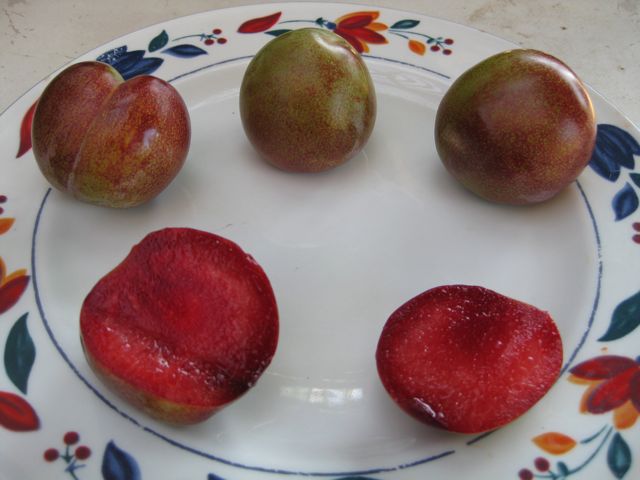
Flavor Supreme Pluot, Fully Ripe


Even though the Flavor Supreme pluot crop (a cross between a plum and an apricot) is usually ready by now, a sample bite might cause you to spit it out. And it did.


 It's easy this time of year to give in to the uncontrollable urge to pick, eat and wince. How can you tell when fruit is ready for harvesting? One way is to download the fruit harvest chart from Dave Wilson Nursery. The problem with relying on that chart: your location, and weather conditions, can vary from the suggested harvest times on that chart. Here's a sensory guide for the most common fruits and berries grown in backyard gardens around here. This year, because of the cool, wet spring, you can add a few more weeks to the harvesting schedule for each variety.

Suggested dates apply especially if you live in the low-lying areas of Northern or Central California. 
   Apples - Harvest varies from July to October; look for bright red color or a delicate blush overlaying the yellow base. Fruit should release easily from tree with the stem intact.
   Apricots - Mid-May through early July; color changes from dull greenish-orange to bright yellow-orange; Flesh is tender and yields to gentle hand pressure.
   Blackberries - Mid-June to early August; color changes from red to black; berries release readily, are soft with tender skin and are easily damaged. Place in refrigerator as soon as possible.

   
Cherries - Mid-May through mid-June, depending on the variety. Net the trees at the first sign of birds eating the fruit. Sample a cherry every few days until they pass your taste test. Keep the stems attached when picking to avoid damaging the fruit. Snipping instead of plucking will keep next year's fruit spurs intact.


 Figs: two harvests, usually: mid-summer and early fall. Harvest figs when their necks wilt and fruits droop.
  Mulberries: Information from the California Rare Fruit GrowersWhite and red mulberry fruits (and hybrid fruits) are ready for harvest in late spring. The fruit of black mulberries ripen in summer to late summer. The fruits of white mulberries are often harvested by spreading a sheet on the ground and shaking the limbs. A surprising quantity can be gathered from a comparatively small and young tree. Black mulberry fruits are more difficult to pick. As the berries are squeezed to pull them loose, they tend to collapse, staining the hands (and clothing) with blood red juice. Unwashed the berries will keep several days in a refrigerator in a covered container. The ripe fruits of the black mulberry contain about 9% sugar with malic and citric acid. The berries can be eaten out of hand or used in any way that other berries are used, such as in pies, tarts, puddings or sweetened and pureed as a sauce. Slightly unripe fruits are best for making pies and tarts. Mulberries blend well with other fruits, especially pears and apples. They can also be made into wine and make an excellent dried fruit, especially the black varieties.

 Nectarines - June to September; most common skin colors start out as yellowish-orange and mature into an orange, red or reddish-pink color; flesh is usually yellowish with red tinge near the pit. Cool immediately.
 Peaches - Mid-May to September; same conditions as nectarines. Newer varieties may be bright red in color with an orange tint.
  Pears - July to October; ready when fruit is full size but still green in color.  Ripen harvested fruit in a cool place (50-70 degrees) until color turns light yellow-green.

 
Plums, Pluots - June to September; color may be solid or mottled red, dark-blue or purple. Flesh is firm yet yielding to gentle hand pressure. Cool fruit immediately.


 Raspberries - June to September; color is red to black, depending on variety. Flesh should be soft, aromatic, juicy; should release easily from cap.
 Table grapes - August to October; Fruit turns from green to reddish-amber, black, bluish, or golden yellow depending on variety. The berries will tend to crush easily and shatter when ripe.

Wednesday, January 26, 2011

Bare Root Fruit Tree Shopping? Buyer Beware!

Mid-winter is bare root fruit tree shopping time here. And who can't resist a bargain? This is the time of year to find truly inexpensive, fruit or nut-bearing trees.


And gardeners on a budget might start their shopping at the big box stores, where many bare root trees are priced under $20.

But beware. 

Unlike local, independent nurseries that tend to stock fruit and nut varieties that perform well in your locale, the box stores get in varieties that may be better off at their sister box store...in the desert.

Case in point:
 
 Last Wednesday, I shopped the nursery section at a local big box store in Elk Grove (Sacramento County, CA) and a locally owned, independent nursery. The bare root fruit trees available at the box store took up about six pallets, approximately 20 trees per pallet, each with their root ball encased in a sealed plastic bag. 

If you read the blog post about choosing and planting bare root fruit trees, you know that examining the roots is an important selection criteria. You're looking for healthy roots! Kinda hard to do that when the roots are in plastic.
There were only 5 peach and nectarine varieties available at the box store: Florida Prince peach, Early Elberta peach, Earli Grande peach, Panamint nectarine and Gold Mine Nectarine.
To the casual shopper, the reaction might be: "Oh boy, peaches and nectarines!"
But to the Sacramento-area gardener who came armed with a copy of the Sunset Western Garden Book or the online catalog of wholesale fruit tree grower Dave Wilson Nursery, the reaction is probably: "These are all low chill varieties, better suited to the desert!"
Yep, it is not unusual for the sales staff at the headquarters for a large chain store to choose fruit tree varieties based on price and appropriateness for the majority of its customers (lots more people down in So Cal). Hence, their selections may include trees better suited for warmer winter areas. Or, someone at big box store headquarters thinks Sacramento is in the desert.

Fruit trees need a certain number of "chill hours" during the winter in order to induce dormancy to allow them to produce well the following spring and summer. A "chill hour" is any hour below 45 degrees, between November and February. 

Here in the Central Valley, 600-800 chill hours are normal. Right now, in late January, the total chill hours for parts of Sacramento County is nearly 900 hours. That total is plenty for most peach and nectarine varieties, including the tastiest ones. 

In Southern California, "chill hours" don't amount to much. Many parts of Los Angeles and Orange County right now have accumulated less than 200 chill hours. So, the only deciduous fruit trees that succeed there are the ones with low-chill requirements.
"Most low chill varieties don't have great taste," says Ed Laivo of wholesale grower Devil Mountain Nursery. "They give up flavor to be a low chill variety."

And sure enough, if you check out the Dave Wilson Nursery fruit taste test results, you won't find any of those big box store peach and nectarine varieties in the Top 10. Or the Top 20. 

The fruit taste tests have been conducted at Dave Wilson Nursery since 1993, with a panel of several dozen taste testers sampling up to 30 fruits at each setting. And they're not just the varieties sold by Dave Wilson Nursery. Over 1600 varieties of fruit have been taste tested over the years.

 The False Allure of Low Prices

The casual gardener shopping at the box store may also note the bare root fruit tree price tag, "$15.99", and be willing to give it a try at that comparatively low amount.
But how happy will that casual gardener be with those selections in a few years, if no one will be pleased with the taste or production?

Down the street at the local nursery, the price for a bare root peach or nectarine tree is approaching $25-30. But at that local nursery, the selection is much better. On the day I was shopping, the local nursery had 22 peach varieties and 16 nectarine varieties! Most, if not all, were trees that would thrive here locally, producing fruit that has scored high in fruit taste tests, including the top winners in Dave Wilson Nursery's overall scorecard: the Arctic Jay white nectarine, Indian Free white peach, Snow Queen white nectarine, O'Henry peach and the Arctic Supreme white peach.

Dave Wilson Nursery Fruit Tasting Results
 
At the local nursery, there was no plastic wrap guarding a root inspection of their bare root fruit and nut trees. As at many local nurseries, the roots of bare root fruit trees are plunged into a moist mix of sawdust and compost. A customer can easily pluck out a tree and examine the roots (you're looking for moist, plump, healthy roots).

Another reason to avoid low-chill requirement fruit trees, if you can: they tend to bloom too early. A fruit or nut tree that blooms too soon (January) in Northern California is asking for a whipping from the rest of the winter storms that come in February and March. The spread of rain-borne disease spores such as brown rot is increased when the blossoms are exposed.

So, when is a bare root fruit tree bargain not a bargain? When it's not the right tree for the right place. 

Whenever shopping for trees, shrubs, annuals or perennials, toting along a copy of the Sunset Western Garden book or calling up a good online reference on your smart phone is good plant insurance.


Tuesday, June 30, 2009

Try a Pluot for a Sweet Smile

    The mild days of spring 2009 are starting to make this summer a great one for luscious, sweet, homegrown fruit. The cherry crop was excellent; apricot aficionados are very happy; the blueberries here in the Central Valley of California are the best ever (“ever” being about a decade, since the introduction to our area of the southern highbush blueberry, which is much more heat tolerant along with a lower winter chill requirement).
    
And now appearing at farmer's markets, some supermarkets and ideally in a backyard garden near you: the pluot. This plum-apricot cross is probably the sweetest, juiciest fruit you can grow. Pluots have predominantly plum parentage and smooth skins like plums.


     The sweet taste of homegrown pluots is preferred by many to the taste of the varieties available in stores. In other words, the pleasant taste of a store-bought pluot does not do justice to biting into one, freshly picked from the backyard orchard. And that is especially true for the Flavor Supreme pluot (right).


    "When people see a pluot for the first time, they think it is just another plum," says Ed Laivo of Dave Wilson Nursery. "Then, they taste it and their eyes get wide. The wonderful flavor catches them totally off guard."

     Yes, Ed is a salesman. But what he says about first reactions to a pluot only hint at the excitement that the initial taste generates. It’s always a treat to take a box of home grown pluots, especially the Flavor Supreme pluot, into the radio stations and wait for the feedback . My favorite response this year: when a couple of the female news reporters bit into the pluot for the first time, they had, we shall say, an “animated reaction”. How animated? An engineer came running into the newsroom exclaiming, “Who’s having an orgasm in here?!?” 

     People like the pluot. Better than sex? Well, it is safer, and more nutritious, with three grams of dietary fiber per serving (as well as protein, carbohydrates, Vitamin A and everybody’s favorite, 15 grams of sugar). Please, feel free to insert your own joke here.


    The pluot was developed by Floyd Zaiger, who began tinkering with Luther Burbank’s hybrid, the plumcot. According to the Zaiger webpage, each year the Zaigers plant tens of thousands of new seedlings, each tree the result of a controlled cross of two parent trees from their vast inventory of breeding stock. Parent trees for seed and pollen are maintained in movable containers, allowing the Zaigers to accomplish a very large number of crosses each spring.


     Besides pluots, the Zaigers invented apriums and the peacotum (peach/apricot/plum hybrids). Also under development: white apricots, flat peaches and nectarines, albino selections and fuzzy plums. Promising selections from the primary seedling blocks are advanced for further evaluation by propagating the varieties onto rootstocks in secondary orchards. The cream of the crop varieties in the secondary orchards are evaluated each week during the fruit season by a team comprised of Zaiger personnel, industry experts and Dave Wilson Nursery representatives.


     In the annual taste tests held at the Dave Wilson Nursery growing grounds in Stanislaus County, the Flavor King, Dapple Dandy and Flavor Supreme pluots are consistent Top Ten favorites among all their tree-grown fruit.


    Backyard gardeners can extend their pluot harvest season by planting those three varieties, along with several new introductions. The Flavor Supreme was ready in late June. The Flavor Queen, a pluot with green-yellow skin and an amber-orange sweet flesh, can be harvested in mid-July through August. That's followed by the Dapple Dandy, then the Flavor King. The fruit from those trees are sure to please your summertime guests. Other delectable pluot varieties include Flavor Delight (which has an early June ripening dates), Geo Pride and Emerald Drop (late July), Flavor Grenade and Flavorich, which can produce fruit after Labor Day.


    Because they can be trimmed to stand no higher than seven feet tall, pluot trees don't require much backyard space. A sunny spot and weekly watering will suffice. Pluots can be pollinated by another pluot or a Japanese plum tree planted nearby. For a season long harvest of pluot varieties, check out this harvest calendar at Dave Wilson Nursery.